Best Online UX Design Courses in 2026: Ranked and Compared

This article includes affiliate links, which help support this website at no extra cost to you. Learn more
Most UX design courses cover the same core skills: user research, wireframing, prototyping, and usability testing. What separates a good course from a great one is how you learn. Some designers thrive with a mentor reviewing their Figma files every week. Others prefer bite-sized lessons they can fit between meetings. And some want a structured 6-month program that builds their portfolio from scratch.
This guide compares four UX design courses for beginners, from subscription-based programs with free trials to a mentor-led bootcamp with career services. Use the comparison table to find your fit, then dive into the detailed breakdowns below.
Best Online UX Design Courses in 2026
Whether you want to break into UX from a different field or sharpen foundational skills, these courses cover the core competencies employers look for: user research, information architecture, wireframing, prototyping, and usability testing. The table below compares all courses at a glance, followed by detailed breakdowns.
1. Interaction Design Foundation:
User Experience: The Beginner's Guide
LEVEL: Beginner
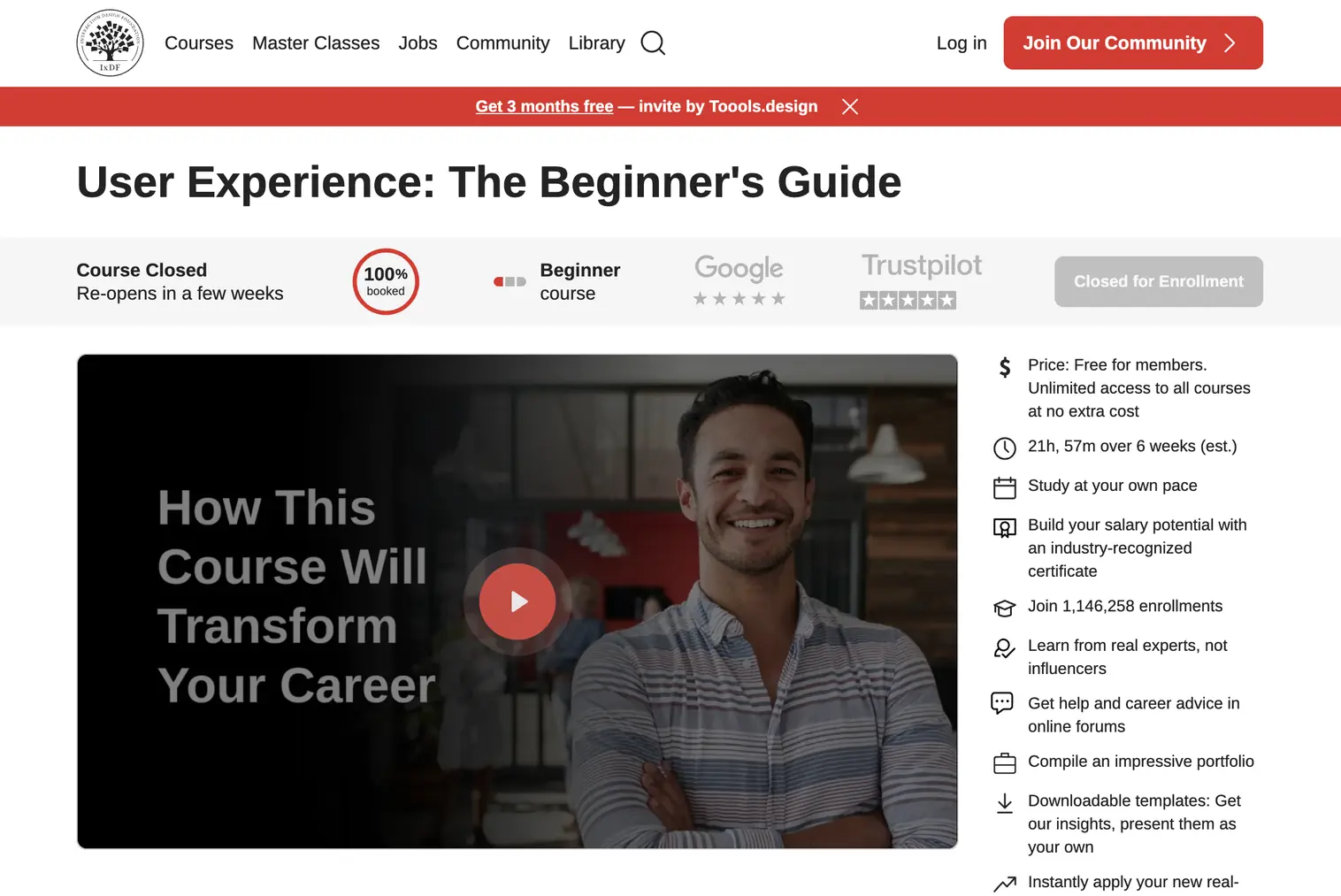
This comprehensive course from the Interaction Design Foundation covers the entire UX design process from understanding what UX is to conducting user research, creating personas, building prototypes, and running usability tests. With over 1.1 million enrollments, it ranks among IxDF's most popular courses.
Key Features
- 22 hours of content spread over 6 weeks covering UX fundamentals, design thinking, user research methods, prototyping, usability testing, and real-world design processes
- Taught by industry leaders including Don Norman (father of UX design and author of "The Design of Everyday Things"), Mike Rohde (author of "The Sketchnote Handbook"), and Alan Dix (author of "Human-Computer Interaction")
- Hands-on portfolio-building exercises with downloadable templates and step-by-step guides for user interviews, personas, journey maps, and paper prototypes
- Covers both UX theory and practical application, including how to work on agile teams and navigate design handoffs
- Graded by experts, not machines, with an industry-recognized certificate
Pros
- Exceptional instructor lineup with Don Norman, one of the most influential voices in UX design
- Beginner-friendly with no prior design or technical background required
- IxDF membership grants unlimited access to all 40+ courses, making it highly cost-effective
- Practical portfolio exercises you can complete alongside the coursework
Cons
- Requires IxDF membership to access (no single-course purchase option)
- Self-paced format demands self-discipline to stay on track
- No live mentorship or instructor interaction without upgrading to Design League
Ideal For
This course suits complete beginners and career changers who want a thorough introduction to UX design taught by the field's most respected experts. It works best for self-motivated learners who prefer structured video lessons with portfolio exercises they can complete at their own pace.
Tip
With this link, you get the IxDF membership for $198/year (regularly $264), including masterclasses for just $5 each (normally $50).
Available masterclasses include:
Design for the 21st Century with Don Norman
How to Conduct Effective User Interviews
How to Use AI Ethically in UX Research: A Practical Guide
Behavioral Design 101: How to Design for Behavior Change
Boost Mobile UX with UX Design Principles and Best Practices
Data-Driven Design: Metrics That Drive Real Results
Align Teams, Save Time and Reduce Stress with Communication Systems
Accessible and Inclusive Design Patterns
... and many more
2. Coursera:
Google UX Design Professional Certificate
LEVEL: Beginner | Free Trial Available
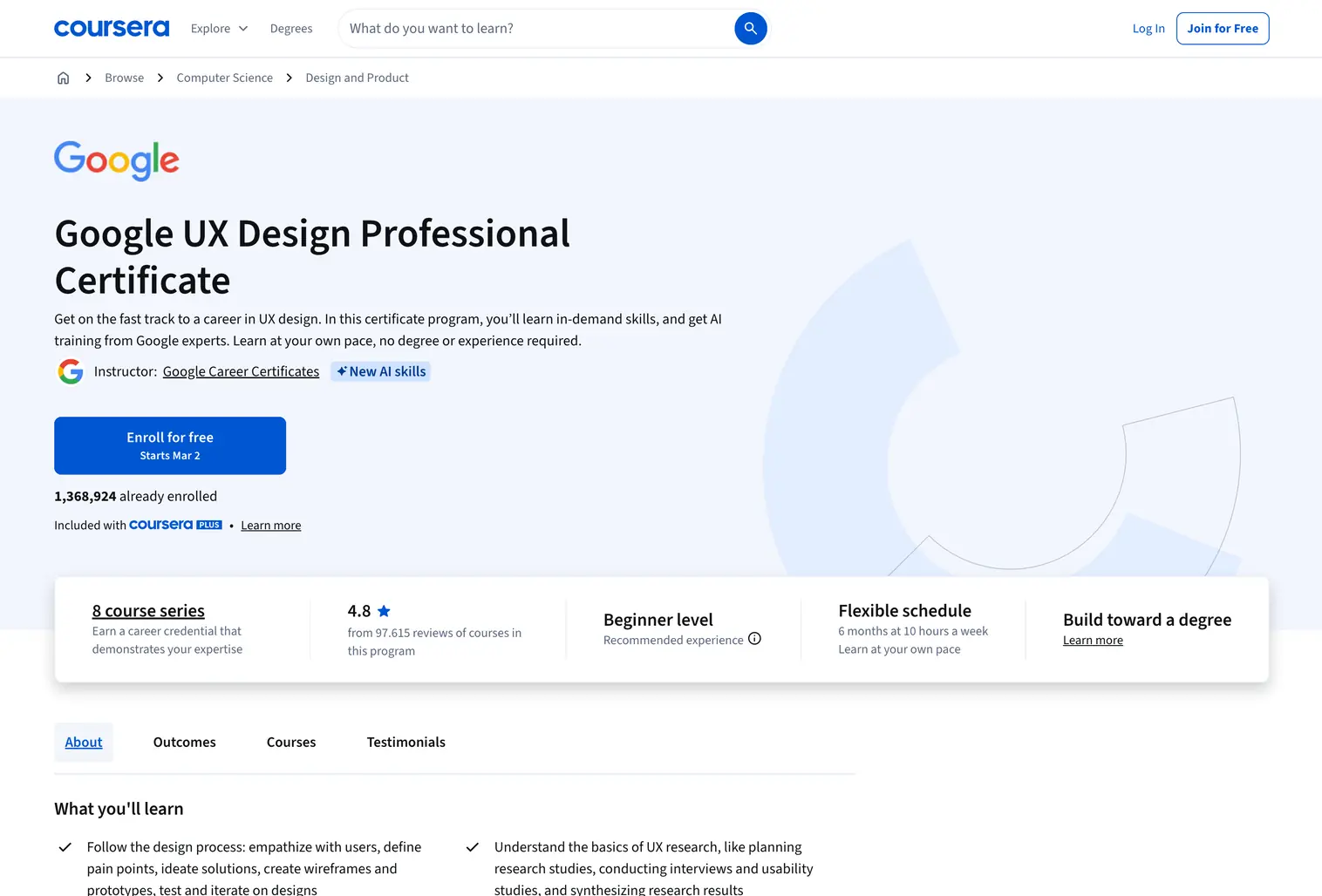
This seven-course program from Google takes you from zero to portfolio-ready in UX design. You cover user research, wireframing, prototyping, and usability testing while building three portfolio projects. With over 1.6 million enrollments in the first course alone, it has become the most widely adopted entry-level UX program globally.
Key Features
- Seven-course series totaling approximately 6 months at 10 hours per week, structured as a clear progression from foundations to portfolio completion
- Course sequence covers: UX foundations, the design process, wireframing in Figma, UX research methods, prototyping and testing, responsive web design, and portfolio project completion
- Hands-on projects throughout; you build three complete case studies for your portfolio using Figma
- Taught by Google UX designers and researchers who share real-world workflow examples
- Shareable Google Career Certificate upon completion; free 7-day trial available
Pros
- Google-backed certification carries strong recognition among employers and recruiters
- Structured curriculum with a clear week-by-week progression and built-in deadlines
- Portfolio-focused: you graduate with three case studies ready for job applications
- Free audit option available; only pay if you want the certificate and graded assignments
Cons
- Significant time commitment at 6 months, longer than any other course in this list
- Monthly subscription cost adds up over the full program duration
- Broad coverage means less depth on advanced topics like interaction design or design systems
Ideal For
This certificate suits beginners and career changers who want a structured, credential-backed path into UX design. Best for those who prefer a guided curriculum over self-directed learning and value having a recognized brand name on their resume.
3. Designlab:
UX Academy
LEVEL: Beginner to Job-Ready
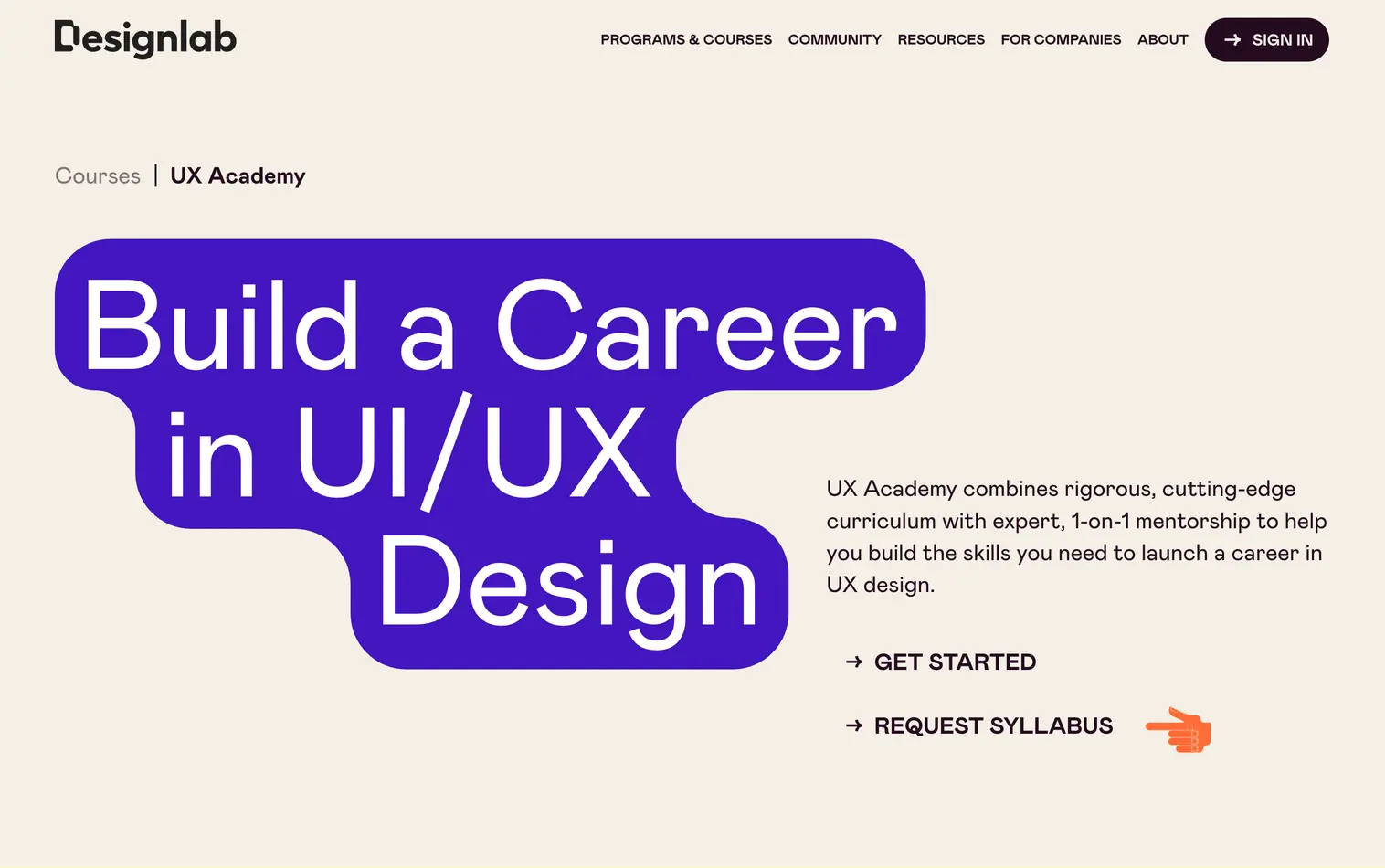
Designlab offers a two-step path into UX design. You start (optionally) with UX Academy Foundations, a 4-8 week course that teaches visual design principles, UI fundamentals, and Figma proficiency through 1:1 mentorship. From there, you can continue into UX Academy, an intensive bootcamp covering the full UX/UI design process with portfolio projects, career coaching, and real client work. The Foundations tuition ($499) transfers as credit toward UX Academy if you continue.
Key Features
- Step 1 — UX Academy Foundations (4-8 weeks, $499): Covers color theory, typography, alignment, hierarchy, and layout principles. You build Figma proficiency from basics to designing full web pages and mobile screens, with exposure to AI tools. Includes eight 1:1 mentor sessions via video call and weekly peer group critiques.
- Step 2 — UX Academy (~6 months, from $8,499): Full career-track bootcamp covering user research, information architecture, interaction design, UI design, and iteration. You complete three in-depth capstone projects (including one real client project) and graduate with a professional portfolio. Includes 1:1 mentorship throughout and dedicated career coaching with resume, interview, and networking support.
- Foundations tuition applies as $499 credit toward UX Academy if you enroll within 7 months
- Active Discord community connects you with current students and alumni
- Payment plans and financing through Climb Credit available for UX Academy
Pros
- 1:1 mentorship at every stage provides personalized feedback unavailable in self-paced courses
- Clear progression: test whether UX design is right for you at $499 before committing to the full bootcamp
- Real client project in UX Academy gives you portfolio work that goes beyond classroom exercises
- Career services include coaching on portfolio, resume, interviews, and salary negotiation
Cons
- Full UX Academy represents a significant investment at $8,499
- Fixed cohort schedules with weekly deadlines require consistent time commitment (20 hours/week for UX Academy)
- Foundations focuses on visual/UI design; UX research and strategy start in UX Academy
Ideal For
Designlab works best for career changers who want a guided, mentor-led path from zero to job-ready. Start with Foundations to build your design fundamentals and test the format. If you're committed to a career switch, UX Academy provides the portfolio, credentials, and job search support to make it happen.
4. Uxcel:
UX Designer Career Path
LEVEL: Beginner to Intermediate | Free Tier Available
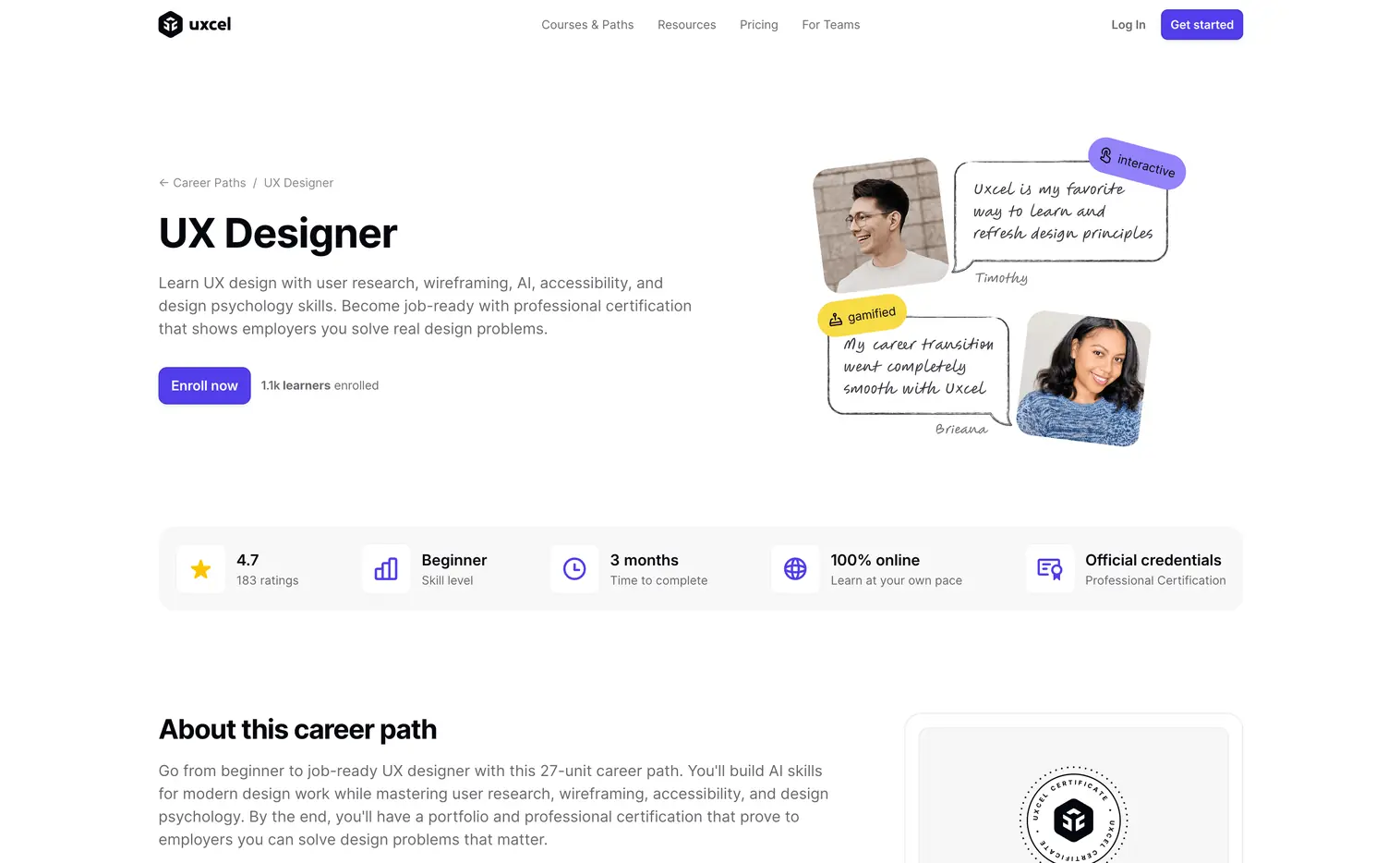
Uxcel's UX Designer Career Path structures multiple courses into a guided learning track that covers the full UX skill set. Using Uxcel's signature bite-sized format with 5-minute interactive lessons, you build skills incrementally through gamified progress tracking, assessments, and real-world exercises. Over 500,000 learners used the platform.
Key Features
- Structured career path combining multiple UX courses into a guided progression from fundamentals to professional-level skills
- Bite-sized, interactive lessons you can complete in 5 minutes each, with gamified streaks and progress tracking
- Skill Graph visualization benchmarks your abilities against other learners and identifies gaps in your knowledge
- Covers UX research, wireframing, prototyping, usability testing, information architecture, and UX writing
- Shareable certificate upon completion for LinkedIn profiles; mobile app available on iOS and Android
Pros
- Free tier available: first level of every course accessible without payment
- Micro-learning format fits into busy schedules without requiring large time blocks
- Interactive exercises and assessments reinforce concepts better than passive video watching
- Content stays current with regular updates reflecting evolving tools and practices
Cons
- Full course access requires Pro membership ($39/month or $24/month billed annually)
- Bite-sized format covers breadth over depth on individual topics
- No live mentorship or personalized feedback on your work
Ideal For
This course suits designers and career changers who prefer building skills in short daily sessions rather than committing to weekly lecture schedules. Best as a primary learning tool for self-starters, or as a complement to more intensive courses from other providers.
Free UX Design Courses
Budget constraints should not prevent you from learning UX fundamentals. Several options let you start without paying:
Coursera's 7-day free trial gives you full access to the Google UX Design Professional Certificate. Enough time to complete the first course and decide whether the full program is worth committing to.
Uxcel's free tier unlocks the first levels of each course in the UX Designer Career Path, so you can evaluate the teaching style and content depth before upgrading to Pro.
Free learning resources like Laws of UX, The Psychology of Design, and Humane by Design provide foundational knowledge on UX principles without any cost. Explore more fundamentals and principles on TOOOLS.design.
For designers starting their UX learning journey, combining free resources with one paid course often provides the best balance of foundational knowledge and structured skill-building.
What's Next
Pick a course that matches your situation: IxDF for comprehensive, expert-taught UX training, the Google Certificate for a structured 6-month path, Designlab for mentor-led learning to get job-ready, or Uxcel for daily micro-lessons. If budget is tight, start with Coursera's 7-day free trial or Uxcel's free tier and go from there.
Explore TOOOLS.design's UX tools category and the UX designers hub to complement your coursework.
Disclosure: This article contains affiliate links from our partners Interaction Design Foundation, Designlab, Coursera, and Uxcel. TOOOLS.design may earn a commission if you purchase through these links, at no additional cost to you. In fact you may get a discount when using these links. Thank you for your support!